Redbox Instant by Verizon 2.0
In 2012, Redbox and Verizon launched a joint venture: Redbox Instant by Verizon, a new video streaming service. Despite a strong brand partnership, the product struggled to retain customers after their free trial. The main issues were lack of differentiation from competitors, a limited catalog, and usability challenges. I joined shortly after launch as UX Design Lead for Web and Mobile Web, with the goal of improving the customer experience and helping the service stand out in a crowded marketplace.
My Role
-
2.0 Project Lead
-
Web & Mobile Web Lead
Working Group
-
Device Design Leads for Mobile and TV
-
Engineering Leads for all devices
-
Redbox Instant Product Managers
Stakeholders
-
CEO for the Joint Venture
-
Director of Product for the Joint Venture
-
Creative Director for Redbox Instant
-
Engineering Director for Redbox Instant
Version 1.0 Designs

Goals

Remove Barrier of Choice

Decrease
Churn

Increase
Engagment
Challenges
From the start, it was clear that incremental usability fixes alone would not solve the retention problem. Customers described difficulty choosing what to watch — the so‑called “barrier of choice.” Competing services all offered similar on‑demand libraries, and Redbox Instant risked being lost in the noise.
To succeed, we needed a compelling, differentiated vision that addressed the discovery problem head‑on.

Insight & Strategy
While reviewing research notes and sketches, I had a key realization: before streaming, traditional TV made discovery easier because “video sells video.”
Channel surfing gave viewers small previews as they flipped, lowering the barrier to making a choice. This became the foundation of Redbox Instant 2.0:
-
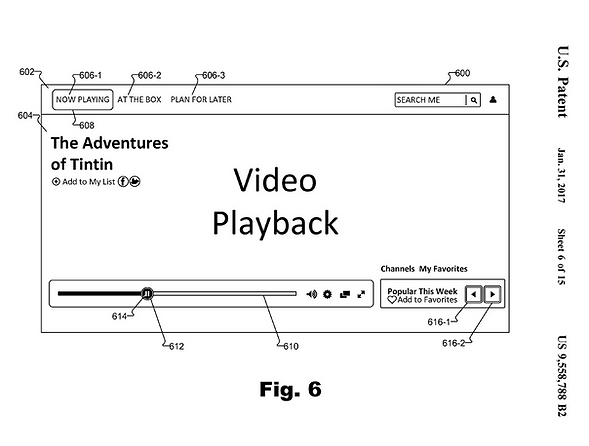
Always‑on video previews that mimic channel flipping.
-
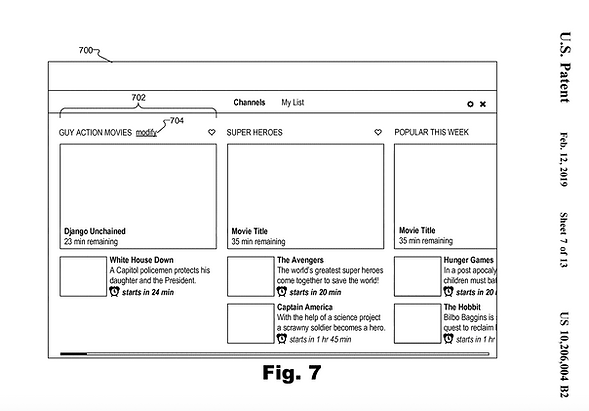
A channel guide curating themed sequences of movies.
-
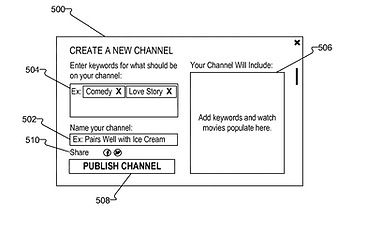
The ability for customers to create their own channels.
This approach aimed to blend the simplicity of live TV with the control of streaming, offering a differentiator no other platform had at the time.
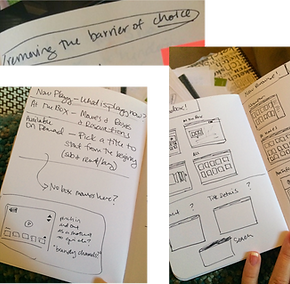
Redbox Instant 2.0 would combine the curated, always on channel flipping of cable television with the customer control of a streaming service. At that time it would have been the only service to do so.

2.0 Redbox Instant by Verizon Prototype
Execution
As the design team iterated concepts, we combined immersive full‑screen channel flipping with a multi‑channel guide view. A member of our design team was also a gifted design technologist. He built a prototype, which we tested with users in a lab setting.
Feedback confirmed the power of the always‑on concept, though it also highlighted areas needing refinement, such as educating users about their control within curated guides.

To build alignment, I collaborated closely with product and engineering leads across endpoints (Web, Mobile, and TV). I presented findings in roadshow sessions to stakeholders, securing buy‑in. When our Creative Director transitioned off the project, I stepped up as Program Lead for the 2.0 initiative, managing cross‑functional delivery planning.
Because each device type had unique technical constraints, I worked with engineering partners to design a phased rollout: starting with static guides on mobile and web updates, then progressing toward full always‑on video experiences across all devices.

Designs
Web
Player view with channel flipping

Results
Although the service was sunset for financial reasons before full rollout, the design‑led strategy demonstrated measurable impact:
-
Usability testing confirmed the always‑on, video‑first model improved discovery and engagement.
-
Average monthly streaming hours increased by +4.6 hours.
-
60‑day subscription stick rate improved by +11%.
-
The iOS app rating improved from 2.5 → 4.5 stars.
-
The team also filed and received 5 U.S. patents for innovations developed through the 2.0 work.

Remove Barrier of Choice
Always on/channel flipping tested well

Decrease Churn
11% increase in stick rate

Increase Engagement
+4.6 hrs streaming

US Patents Awarded
5 patents